Friday, 5 December 2014

Cappadocia


Cappadocia is pronounced “Kappadokya”, and means “land of the beautiful horses”.

This is where we arrived next, a fantastical land of crazy rock formations, cave monasteries and underground cities. If Iceland seemed like another planet, Cappadocia often seemed like another world, one in which unicorns and centaurs might roam (yep, pretty much Narnia). In this world, they often didn't want you flushing toilet paper down the toilet, but putting it into the bin provided instead. Weird.

 
Cappadocia

We stayed at a comfortable hotel recommended by Mark and Joy – funnily enough, they had visited Cappadocia right before they got back to Istanbul and hosted us. The hotel had beautiful lamps and curtains.

pretty, sparkly curtains

The hotel also provided complimentary breakfast, of which we always take advantage. We got a proper taste of Turkish music this way. That's right – they had Turkish music videos playing on the TV during breakfast, and we were treated to the top of the pops (we assume). They reminded us of the Spanish flamenco music (uh oh!); all the songs sounded basically the same, most of them were sad songs about heartbreak, with the same-sounding riffs and chords. One of our hotel hosts informed us one of the singers was a famous gangster, who'd got shot a couple of years ago (and is still alive). Turkey's pop scene is way more exciting than New Zealand's!

We started off our adventures in this land with a wander around the little town we were staying in, Goreme, and visiting the nearby Goreme open air museum. This is apparently the oldest cave monastery in Cappadocia, consisting of numerous churches built into the rocks. Some of these were all painted up inside with icons. Annoyingly, it was always forbidden to take photos inside the ones with pictures on the walls. We found some later on though, elsewhere, where we were allowed to snap away, so if you're hanging out for that you won't be disappointed.


They had carved staircases into the cliffs

 
and into the buildings themselves.

 
Most of the paintings were more interesting than this. This is from the iconoclastic period, when pictures were forbidden. Since this part was outside we were allowed to take photos of it.

To fit as much as possible into our visit, we decided to do a popular guided tour on our second day, the Green Tour, for which we got driven round in a van to several cool destinations between 9.30am and 5.30pm. It was a full van, with about 15 of us, mostly couples, from all over the place – Indonesia, Tunisia, Spain, Chile, South Korea, China, even New Zealand.

Our first stop, after a quick stop at the Goreme Panorama, was Derinkuyu underground city. John describes it:

Derinkuyu is the kind of place that, once you know it exists, makes you wonder why this sort of thing hasn't been done a million times elsewhere already, and then you realise that perhaps it has, and then you get all paranoid about Morlocks.

Derinkuyu is an underground city, with a carrying capacity reaching into the tens of thousands. In this part of Turkey there are hundreds of underground cities which are being discovered all over the place, and some of them have multi-kilometre long tunnels connecting the cities. It's pretty much science fiction. Archeologists think that they were first built by aliens Hittites, as refuges for people to flee to when under attack. The tunnels are cramped, with stone doors that can be rolled over the entrance to tunnels, with holes in the middle, all the better to stab you through. Great stuff. There are ventilation shafts that punch through the layers, and communication tunnels that carry sound, but aren't large enough for people. It's really well thought out, even for a place that would have been built over multiple generations. We were able to go down eight or so layers to the church at the bottom. In the Christian era, there were many Christians who lived here, hiding from persecution underground. On the one hand, it's kind of nice to be underground, away from the extreme cold and heat, but on the other hand, the people who lived there would have been relying on oil lamps and candles for light. Not a very nice thing if you're living there for many months.

Most of the caves were like this.

 A door.

 The big ventilation shaft.

 Some of the tunnels were rather tight. Good thing we don't have claustrophobia.

 
Some parts were rather open and airy. John could even stand up straight!

There were many tunnels where crouching was the order of the day.

 
From the bottom of the ventilation shaft.

It was good to have commentary as we explored, otherwise I think it would've just been a whole bunch of indeterminate underground rooms.

Next up was Selime Monastery, another collection of churches and other rooms dug out of rocks. If the monastery in the Goreme open air museum is the oldest in Cappdocia, this one is apparently the largest. Our guide related how it was initially a monastery, before being converted to a camel stop under the Seljuks.

 Multi-level cave dwellings.

 Most of those holes at the top are accessible via shafts and stairs.

 One of the churches.

Inside another of the churches. The blackened surface is from the fires that were lit inside the buildings when it was a caravan stop, covering any decorations with soot.

After consuming a hearty complimentary lunch at a restaurant, all part of the package tour, we took a walk along the floor of the Ihlara Canyon. We could imagine how it could look beautiful, but in mid-November I don't think it was looking its best. It was still a pleasant walk, especially after the mid-way break, when the guide let John and me go ahead of the rest, who were enjoying cups of tea. This meant we could go at our own pace, instead of at a crawl.

 First stop in the canyon. A church that we're allowed to photograph! This is the ceiling.

Most of the canyon was like this.

 There were a bunch of these little windows and doors at various levels on the cliff walls.

 Yes, one of those.

Where we stopped to have a break.

The guide's instructions to us were clear, and reminiscent of the Bible's: follow the path straight ahead, don't turn to the left or the right, and the van will be at the end. It's straightforward. We mostly went as he directed, but then we saw a sign pointing to the left, to a church up a mere 300 steps or so. We figured we were far enough ahead to pop up and see it. So we did, puffing by the end. Then we rushed back down guiltily, and caught back up to the group as they were nearly at the van. Phew!

 The painted church!

Various saints and/or apostles.

We continued our tour with another great viewpoint over Pigeon Valley, so called because of the niches carved out into the walls of the canyon. The people who carved them used pigeons for three purposes: their eggs as a binding agent for the paint in the frescoes, their droppings for fertilizer, and the pigeons themselves for communication. Hey, just like how they use owls to communicate in Harry Potter! Across the road from the lookout point was a shop selling Turkish Delight. More importantly, it had tons of piles of free samples of the stuff. Mm mmm! Mentions of Turkish Delight always put me in mind of The Lion, the Witch and the Wardrobe. Second Narnia reference!

Our tour concluded with a trip to an Onyx factory, where we saw an expert craftsman carve an egg on a base from a block of onyx, then sand and polish it to a smooth and beautiful surface. This was probably the least exciting part of the day, as we got trooped through to the adjoining shop and invited to survey all the onyx jewellery they were selling, showing us all the different colours it can go in different lights, as well as other kinds of gemstone jewellery. A simple pair of earrings cost 414 Turkish Lira. “Don't worry,” the shop assistant laughed, “it's Turkish Lira, not dollars!” Even so, that's still over NZ$200. I didn't like the dominant colours of onyx anyway – brown and green.

It had been a very interesting day, and we thought the tour well worth it. Funnily enough, given the Turkish tendency to try and sell you as much as they can, I was expecting more pushiness from our tour guide at the different shops we went to, especially as they no doubt have a deal with the tour company that takes us there. However, our guide seemed more the jaded sort, who'd done this so many times he was more inclined to get going. Funny – he made me feel like I needed to go when I might've bought stuff if I'd had longer to browse – the opposite of what I expected!

We still had a full day to go in Cappadocia, as our flight left at 10pm the next day, and we spent it walking. From our 11am check out to our 5pm return to Goreme, we took a walk down Red/Rose Valley, getting slightly lost in the middle, followed by a walk down Love Valley, which turns into White Valley. So many valleys!

The start to the Red/Rose Valley was the roughest of any walk we've done on our trip: narrow tracks for our feet, ladders connecting parts too steep to manage otherwise, scratchy trees grasping at us. I felt a little like Snow White. Once we got beyond that, though, the rest was fairly easy, apart from a section where we lost the trail. The trail was basically arrows, normally accompanied by “red” or “rose”, painted on rocks along the way. This is why we're still not sure whether our first walk was along Red or Rose Valley. Whichever it was, it was great. I've decided the rock formations are what I found most fascinating in Cappadocia, so I enjoyed our walks on the last day the best out of the activities we did there.

For lunch, we stopped at a Kebab World in a tiny town between the two hiking trails. As we walked along eating them, we realized a dog who had come up to us at the takeaway place was – well, dogging us. We figured she wanted the kebabs. We didn't oblige by giving her any. I take a while to eat, but even once I'd finished mine, she was still following us. We had left the town behind, and were walking along the side of the main road. It took us at least half an hour to get from the takeaway place to the start of Love Valley, and John finally commanded her in his best dog language: “Go home!” I suppose it worked, for she finally left us. All the dogs in Cappadocia seem nice and chilled out, roaming around as they do, and she was no exception. Still, there was nothing for her in Love Valley (no metaphor intended).

Initially the track led us down between two banks, so we couldn't see that much of the incredible rocks on either side of us. Then the track started to get wet in places, and I was wearing my holey sneakers, so we clambered up one of the sides, and found a parallel track up there. We did this a couple more times on our way, and got to see more of the amazing scenery. I think White Valley had the most outlandish scenery I saw in Cappadocia; it was the place I most felt didn't really belong on Earth. I sort of couldn't believe what we were seeing. The sense of the exotic was helped by the fact we virtually saw no one else on either of our walks.

 Needs no caption.

 John for scale.

 Parts of the valley were more like a canyon.


bizarro, fabulous landscape in the White Valley


Upon our return to Goreme, there was something we still needed to do. John still hadn't tried a Turkish coffee. So we went to a cafe and he did that. His impressions:

The coffee came in a small cup, basically a gulp's worth of dark liquid. Knowing a little about what I was up against I let it sit for a while before taking a sip. It was creamy and sweet, and not as grainy as I was expecting. Nice. I'd go for it again I think. By the time I got to the dregs, the cup was still half full. I think that's as much as I was meant to have, but I'll have to look it up later if I remember.

We followed that up with a dinner of Turkish pizzas, called pides and mighty tasty, which came with free tea. That wasn't the first time we'd been treated to free tea when out to eat in Turkey, either. We started out on the wrong foot with Turkish hospitality, thanks to the pushy shopkeeper guy in Istanbul, but we had come to really appreciate it by the end of our visit to Turkey! I even tried some tea, traditional as well as the apple variety. The apple was my favourite.

Again, excepting the pushy shopkeeper guy in Istanbul, we had an amazing time in Turkey. The exotic, the fantastical and the free stuff – we loved it.

Tuesday, 2 December 2014

Istanbul


In Istanbul we again enjoyed the luxury of staying with friends/family/parents' friends. In this case, it was my parents' friends, formerly living in Inglewood, Taranaki, now in Istanbul, Turkey. Practically the same place, really! Mark and Joy were very hospitable. On our first night there they met us after the flight and we all headed to a restaurant for dinner; on the second night we were served a lovely homemade chicken roast meal, and on the third night we enjoyed the leftover chicken in a creamy pasta dish. Yum!

But perhaps you are more interested in our sightseeing adventures. Well then. We started our time in Istanbul with a visit to the Topkapi Palace museum.

entrance to Topkapi Palace
We expected it to be more of a palace than a museum, but once we got in I could see why it was called a museum. We got to see numerous fancy structures and rooms, true, especially since our ticket included the Harem section, but a good number of the rooms were used for housing exhibitions, like in a museum.

 a ceiling in the Harem

 in the Harem

 stained glass window in the Harem

 likewise

There were several rooms with lavish, opulent items from the Treasury, be they the rulers' own, gifts from other countries or spoils of war, including several ginormous gems. There was a series of rooms with religious relics, sort of like in some Catholic churches; the items included Moses' staff, David's sword, various swords of various relatives of the prophet, and rather a lot of small reliquaries holding bits of the prophet's beard. There was an armoury, with a sword taller than John. There was a room with timepieces. There were kitchen rooms, with crockery items displayed, as well as the confectionery section, with some extraordinarily intricate jugs for sherbert. All in all, it was most interesting, and we spent longer than expected looking at everything, a good 4 hours or so. If we had invested in the horrendously expensive audio guide, who knows how long we may have spent there!?

 fancy doorway!

fancy doors - mother of pearl!

fancy doorway!

We had a bit of a wander round the touristy area, Sultanahmet, before heading home, and got to see the Hippodrome with an obelisk and a serpent column. We decided the Istanbul tourism department is doing a good job, as the city seems very nice and clean, with Sultanahmet a pretty area for walking around. The metros we took, too, apparently all installed between 1-3 years ago, are all really clean and spacious, without all the graffiti that tends to cover the metros in other places (especially Italy. Especially Rome).

On our way back, striding along with purpose, a random guy hailed us from the side of the street, asking if we were German. We stopped and chatted for a bit, as he was friendly, and kept asking us questions. Where were we from? How long in Istanbul? First time here? You don't have Turkish goods in New Zealand, eh? I let John do most of the talking, as I had been cautioned that it's best for a western woman in the predominantly Muslim nation to a) not expose much flesh and b) probably best to avoid looking at/being friendly with men there. Apparently many of them have a pretty skewed perception of western women as being loose, free and easy, gained from the media. Thanks, celebrities!

Anyway. After a couple of minutes, the roadside guy identified himself as the owner of a shop nearby, and invited us to follow him to get his business card. We had sensed he wanted something. We weren't overly keen to go, but it was just his business card – we could grab it and be on our way. He led us into the shop, and took John down a flight of steps. I decided I'd just wait up there until they came back, but he insisted I come down too – Turkish hospitality! John muttered to me, “We need to get out of here.” Word.

The guy referred back to how we don't have Turkish goods in New Zealand, and started blatantly trying to sell us stuff. He motioned us to some carpets, then suggested other goods when we weren't interested. John reminded him about the business card. He gestured us to look at a smaller carpet instead. I said we really needed to go, and John said if he could just give us his business card, we could come back to have a look (yeah – as if), but that we needed to go now. He directed our attention again to other goods (my specificity shows just how much attention I paid to what he was trying to get us to look at), and we realized there was never going to be a business card. A deceitful ploy! We said we had to go, despite his protestations of Turkish hospitality, said “no, no!” and just rudely left, climbing up the stairs past another guy coming down with a little tray carrying two cups of tea. Another ploy!

We escaped into the fresh air, and managed to get to our ferry 2 minutes before it left to go back over to Mark and Joy's side of the city. See – we really did need to go! Anyway, this dude had picked the wrong couple to try and coerce into a sale. For non-confrontational shoppers such as us, this was the absolute guaranteed worst way to go about getting us in a buying mood. All it did was strengthen my non-buying mood into a definite, absolute, unshakable, on principle opposed to buying a single thing mood.

We never got approached like that again though. Maybe it was the menacing looks we adopted ever after.

The next day we were in a much more amenable mood to buying things, as we headed off with Mark and Joy to the Spice Bazaar, followed by the Covered Bazaar. The Spice Bazaar would have been heaven to our foodie relatives and friends – spices and other exotic food things piled high all round. As it was, I found the other bazaar more interesting. We were still residually suspicious of any friendliness on the part of the shopkeepers, who were still overly outgoing for our liking, but we did have a good time, especially with Mark and Joy expertly guiding us to some of the cheaper shops nearby as well.

Istanbul's famous Covered Bazaar

and inside

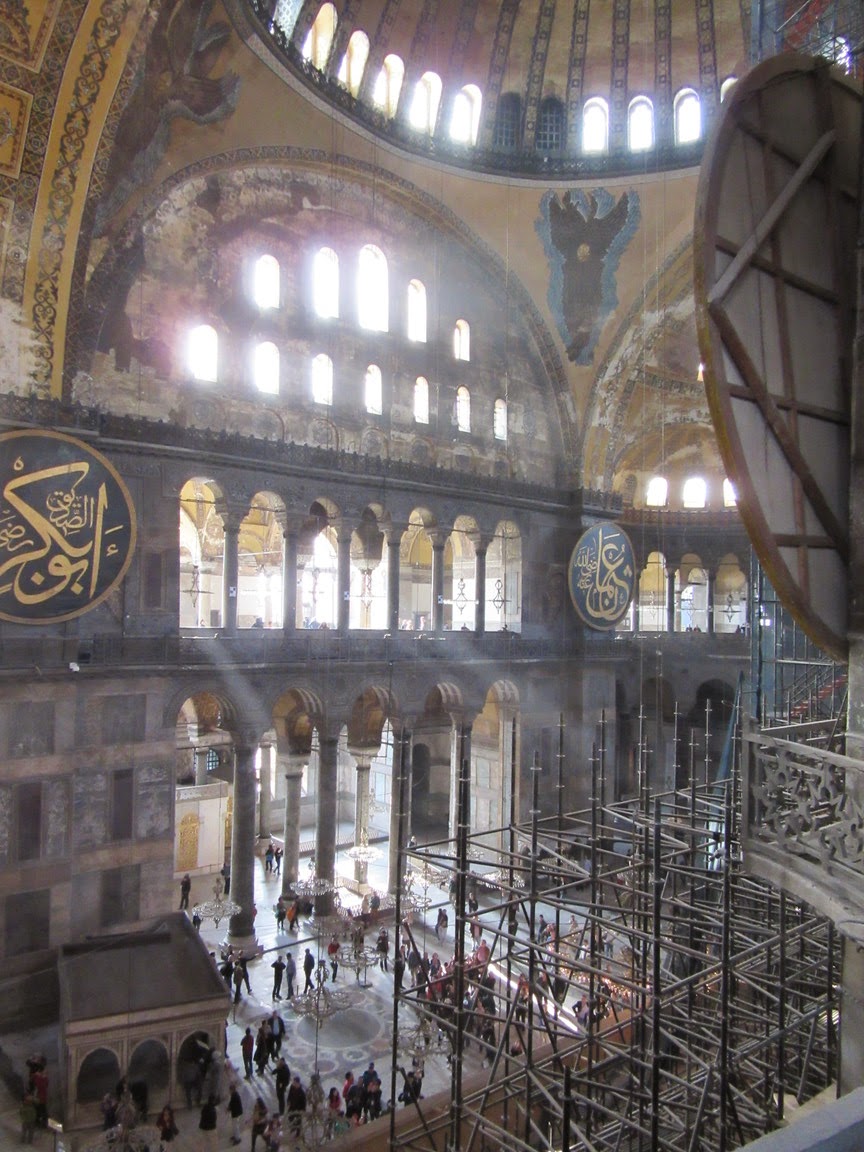
That afternoon we visited the Hagia Sofia – a huge thing! It wasn't the prettiest church – I mean museum, as of 1935 – we've seen, but it was one of the most massive.

a fancy structure out the front
 inside

slightly the worse for wear in parts
 massive!

Massive! Still!

We then went to see the Blue Mosque, me using my hoodie to conform to the head-covering requirements. I had brought my scarf just in case, but my hood seemed to work just as well; in fact, better than the scarves of many other tourist ladies. You could tell who the tourist ladies were by the sloppily-done headscarves, leaving hair poking out in all different directions (the hoodie was also a dead giveaway). Anyway, the mosque itself was fancy, with pretty designs on the walls. It was also pretty packed with all the visitors.

 the outside of the Blue Mosque, and John

big inside, too
pretty!

We ran into Mark and Joy again at the ferry port, after they had spent all day shopping, and they took the opportunity to show us some proper baklava (I always want to write balaclava). They took us to the best baklava place in Istanbul, and John and I tried a plate of 6 different types of pistachio baklava. It was delicious! Very sweet, and yet somehow we managed to finish it all between the two of us (pigs).

On our last day in Istanbul we visited a trio of museums, starting with the biggest, the Archeological Museum. We saw a range of items from Cyprus and the ancient Middle East – most interesting for me was an inscription from a tunnel built by King Hezekiah as a precaution/preparation for a siege! - as well as a bunch of statuary and archeological finds from the Istanbul area over the centuries, which mainly looked very similar to what we'd seen in the Athenian Archeological Museum.

There was also a section on the excavation of Troy, divided into the different layers which corresponded to the different settlements that had existed there. The exhibits mainly consisted of pottery shards; I believe this was because the guy excavating it was most interested in what lay at the bottom of all the layers, convinced he would find Hector's palace, so he was rough and careless with the rest of it as he dug through. Indiana Jones would be shocked! as Indy always takes the delicate approach to archeology. It's always interesting to see supposed mythical tales by Homer and the like being validated by archeology, though, so good on rough archeological dude for that part, at least.

The part of the museum I liked best was the translations of cuneiform tablets. You can look all you like at vases and pottery and not learn too much about how people lived and thought in the ancient past, but reading what they wrote provides a great window. There were mythological stories, receipts and records of loans, parts of laws and records of import taxes; there was a note about a group of smugglers, one of whom was getting cold feet, and it was up to one of the group to make sure things still turned out alright; there was also part of a letter from a queen petitioning the king from another land to send her one of his sons as her new husband, as her first one had died. There was a note under the last inscription saying that apparently the son that was sent was murdered on the way. Intrigue!!! There was a whole section of the museum closed for renovation, but even so, it took us a decent length of time to get through what was open.

Next was the Tiled Kiosk Museum, which contained brightly coloured rooms – covered with tiles, come to think of it – displaying various ceramic crockery in the centre of the rooms. We'd gazed our fill of crockery in the kitchen room section of Topkapi Palace, so we looked round this place in about five minutes.

Last was the Museum of the Ancient Orient, which both John and I found the most interesting of the three. I think I've fallen prey to the “bigger is better” mantra, and tend to find the bigger things interesting in museums. There were mummy cases from ancient Egypt, big statues of people and animals, big tiles taken from the wall of Babylon depicting mosaics of animals, big friezes displaying a procession, as well as lots of slabs depicting banquets and feasting. It must have been a popular activity back then and there.

After our museum visits it was time to be off, taking the metro for an hour to catch the shuttle bus to the other Istanbul airport. Mark very kindly accompanied us to see us off. It was perfect timing to catch the bus, which was just as well, as it took 80 minutes to get to the airport – twice as long as we were expecting – due to terrible traffic, I think. You will be delighted to learn that once we arrived, however, we got on our next flight without any problem. Whither? Come back next time to find out!

Monday, 1 December 2014

Athens


Capital City #18

We arrived in Athens having enjoyed a break from pushy salesmen and crowds of tourists. With our return to a more typical tourist destination, however, came the usual crowds of people seeking to sightsee and to sell. We ventured into at least three shops where everything was “50-60% off”! It was incredible. Such consistently incredible sales! We were hard sells, though, and resisted all the super deals so well we didn't buy a single souvenir. Bad tourists!

Our first tour of the city yielded some interesting sights, including the National Gardens, the Parliament building, the Temple of Olympian Zeus, Hadrian's Arch and many policemen around the place. Seriously, Athens had the largest police presence we've encountered in our whole trip so far – including the US. There were multiple police buses around the place, as well as small groups of policepeople stationed at various points. We're not sure if it was for something special, or is a regular feature of Athenian life. Another unique aspect to Athens was the abundance of sleeping dogs around the place, generally in the sun, some of which looked pregnant. We let them lie.

 Hadrian's Arch

leftovers of the Temple of Olympian Zeus


We also saw part of the changing of the guard ceremony (we presume) at the Tomb of the Unknown Soldier, which was a pretty great performance.


 On our second day, we visited the Acropolis, as you do, which contained the Parthenon and the Erechtheion. The Parthenon is being restored, it would seem – a task I imagine will take a while – so it joined the swelling ranks of famous European landmarks to have scaffolding around it (not all the way, though). It was definitely a big ol' fancy remains of a building. There also weren't too many other tourists there, which was nice. It's good to be in touristy places in the off-peak season.

A mostly scaffoldingless view of the Parthenon.

We made sure to explore the surrounding area quite thoroughly, and in doing so stumbled upon a couple of tortoises hanging out. That was unexpected!

 
one of the tortoises

We also saw the Theatre of Dionysos, as well as some formerly sacred caves. The Acropolis sits on the top of a rocky hill that has been enclosed in walls, so it looks like a fortress – it was used as a fortress until relatively recently, which makes sense given its commanding view over the city. The caves dedicated to various deities, or used in various rites were sometimes secret entrances into the Acropolis, useful if you're a besieging army, or a besieged populace.

looking down one side near the Acropolis

One of the views in the surrounding area - Theatre of Herodes Atticus.

We also managed to see Hephaiston's Temple in the Agora, an impressively intact structure given its old age, as well as the Areopagus, where Paul famously preached to the Athenians. It was basically a pile of rocks. We presume there was more to it in Paul's day.

 Hephaiston's Temple - so intact!

the Areopagus

The downside of visiting in an off-peak month is that the attractions close earlier. In the case of the ancient sites, this was at the ridiculous hour of 2.30 or 3 o'clock. So we ended up walking around some sights from the outside instead, which often worked fine, since you could see everything through the fence anyway. In this way we admired the Roman Agora, Hadrian's library and other ruins. Athens has lots of ruins all over the place, not just the famous ones; we'd just walk down a street and encounter a fenced-off section containing excavations, or see excavations at a metro station, discovered when they were building the metro line.

Hadrian's library (we think)

On the third day, we took a bus trip out to Cape Sounion, to see another temple – Poseidon's this time. It was an appropriate location for a sea god's temple. The temple itself was big and imposing. Perhaps we should have been more impressed by our fellow visitors, but we're not sure. We happened to time our visit with that of an Arabian-looking Muslim couple, along with a man in a suit. Another man in a suit was obviously an attendant, and another couple was showing the group round. The primary way we could tell they were important, though, was the 6-8 policepeople accompanying them like bodyguards. We made sure not to make any murderous-looking moves, so we were fine. We still don't know who they were, though. Saudi royalty? If so, we feel more important by virtue of our proximity to them. As it is, we only feel slightly more important in an uncertain way.

view from Cape Sounion
the star attraction

We managed to get dropped off near the Acropolis on our return journey, and dined at a nearby restaurant that night. We were served by the wryest waiter we've ever known. He asked us if we were going to be participating in the marathon that weekend. Indeed, the weekend we were in Athens, they were redoing the original marathon – from Marathon to Athens. We had decided not to participate in this particular event, and told the waiter so. We tipped him happily after the meal, grateful to have experienced reticence in the tourism sector for once. As for marathon runners, we saw some the day we left in Athens, running along not too far from our accommodation, with all the streets nearby closed to traffic.

That night we visited the Acropolis Museum. What were you doing on Friday night, November 7? We were at the museum late night. That's how we roll. We so down wit it. It was pretty rocking there, too. We saw many many statues of Athena, as well as the friezes that used to adorn the Parthenon and other buildings – what's left of them, anyway, which is still a fair amount, following multiple centuries and Lord Elgin's looting. ELGIIIIN! Naughty! Many of the statues were in remarkably good condition; some even had a bit of the original paint left on them. We learned this was due to the defeat and ensuing destruction of Athens by the Persians in about 480BC, whereupon the Athenians buried the surviving statues, preserving them in great condition for museum visitors a couple of millenia later!

We followed up our museum night with the National Archeological Museum the next day. This traced the history of all of Athens from prehistorical times up to about the end of the Roman period. It was fascinating to see the evolution in art style as we followed the statues through from several centuries BC to the inevitable Roman emperor busts in the first few centuries AD. Realism really came into its own in ancient hellenistic art. Most of the exhibits were statues, tombstones, steles and busts. I realized I'm used to a combination of sculpture and paintings in art museums we visit, and it seemed like something was missing at this museum – I was feeling the lack of traditional paintings. The ones that are preserved are, of course, on the vases and other pottery vessels. There was a big collection of these upstairs.

This is how you get down wit it in ancient Athens. The men are dancing with females, whom you can only just make out.

 the horse and his boy

 a theatrical mask

 two thumbs up! Another guy gambolling.

Poor Athena, not quite as attractive since she lost her nose, I imagine.

On our way back from the Archeological Museum we saw a street performance by a Korean tai kwon do group (we think). It was cool, and different from the typical busking we've seen. As we watched, we opined that this was something we would not see in New Zealand.

We finished our time in Athens by getting all the paganism out of our system with a visit to church! Like most of the others we've visited, John found it online, and saw they held to the 1689 Baptist Confession. We were so there – we're all down with proclaiming the Pope the antichrist (jks)! It turned out to be a pretty tiny church; John and I made up 1/4 of the total congregation size, though a few others joined the fellowship time afterwards. We sang the songs a cappella, and the pastor preached on Galatians 3:6-9. It was pretty great. It was nice to hear expositional preaching again, and he spoke on one of the key elements of the gospel: being declared righteous before God is only possible through faith in Jesus, rather than any works we can do. He pointed out this is what makes Christianity different from every other religion. Rather than us amassing so many righteous deeds to get ourselves declared righteous by God, an impossibility for sinners like us when standing before a perfect and holy God, God declares us righteous while we are actually yet sinful. The pastor cross-referenced a couple of passages to explain how the righteousness “counted to us” means that we are “considered as” righteous even when we're actually not. And the only way God can do this and still be just, punishing sin as it deserves, is for us to put our faith in Jesus and what He accomplished on the cross, when He bore our sins, guilt and punishment in our place. For a fuller picture of what the gospel is all about, read the Bible (maybe starting with John).

Back to our experience of the city – Athens is built quite literally on the ruins of former greatness, like an aged rock star going on tour one last time; no one wants to hear any of the new stuff, they're just there for the old hits they can sing along to, and to be part of the experience, to be able to say “I was there” along with thousands of others before. The ruins are just that – ruins, husks of buildings and monuments that hark back to the day when Athens was great. In one sense, once you've seen one marble pillar, you've seen them all, and every ruin that you visit after this is just a slightly different configuration of blocks and pillars, derelict and abandoned. In spite of that, those broken and vandalised structures still have some quality that defies objective aesthetics. That's why we were there of course, for the history. To look at the marble foundation slabs nestled in the dry grass, to climb up Mars Hill, wander through the Acropolis, and to be able to say “We were there.”

So were these people. A protest of some sort.