Tuesday, 2 December 2014

Istanbul


In Istanbul we again enjoyed the luxury of staying with friends/family/parents' friends. In this case, it was my parents' friends, formerly living in Inglewood, Taranaki, now in Istanbul, Turkey. Practically the same place, really! Mark and Joy were very hospitable. On our first night there they met us after the flight and we all headed to a restaurant for dinner; on the second night we were served a lovely homemade chicken roast meal, and on the third night we enjoyed the leftover chicken in a creamy pasta dish. Yum!

But perhaps you are more interested in our sightseeing adventures. Well then. We started our time in Istanbul with a visit to the Topkapi Palace museum.

entrance to Topkapi Palace
We expected it to be more of a palace than a museum, but once we got in I could see why it was called a museum. We got to see numerous fancy structures and rooms, true, especially since our ticket included the Harem section, but a good number of the rooms were used for housing exhibitions, like in a museum.

 a ceiling in the Harem

 in the Harem

 stained glass window in the Harem

 likewise

There were several rooms with lavish, opulent items from the Treasury, be they the rulers' own, gifts from other countries or spoils of war, including several ginormous gems. There was a series of rooms with religious relics, sort of like in some Catholic churches; the items included Moses' staff, David's sword, various swords of various relatives of the prophet, and rather a lot of small reliquaries holding bits of the prophet's beard. There was an armoury, with a sword taller than John. There was a room with timepieces. There were kitchen rooms, with crockery items displayed, as well as the confectionery section, with some extraordinarily intricate jugs for sherbert. All in all, it was most interesting, and we spent longer than expected looking at everything, a good 4 hours or so. If we had invested in the horrendously expensive audio guide, who knows how long we may have spent there!?

 fancy doorway!

fancy doors - mother of pearl!

fancy doorway!

We had a bit of a wander round the touristy area, Sultanahmet, before heading home, and got to see the Hippodrome with an obelisk and a serpent column. We decided the Istanbul tourism department is doing a good job, as the city seems very nice and clean, with Sultanahmet a pretty area for walking around. The metros we took, too, apparently all installed between 1-3 years ago, are all really clean and spacious, without all the graffiti that tends to cover the metros in other places (especially Italy. Especially Rome).

On our way back, striding along with purpose, a random guy hailed us from the side of the street, asking if we were German. We stopped and chatted for a bit, as he was friendly, and kept asking us questions. Where were we from? How long in Istanbul? First time here? You don't have Turkish goods in New Zealand, eh? I let John do most of the talking, as I had been cautioned that it's best for a western woman in the predominantly Muslim nation to a) not expose much flesh and b) probably best to avoid looking at/being friendly with men there. Apparently many of them have a pretty skewed perception of western women as being loose, free and easy, gained from the media. Thanks, celebrities!

Anyway. After a couple of minutes, the roadside guy identified himself as the owner of a shop nearby, and invited us to follow him to get his business card. We had sensed he wanted something. We weren't overly keen to go, but it was just his business card – we could grab it and be on our way. He led us into the shop, and took John down a flight of steps. I decided I'd just wait up there until they came back, but he insisted I come down too – Turkish hospitality! John muttered to me, “We need to get out of here.” Word.

The guy referred back to how we don't have Turkish goods in New Zealand, and started blatantly trying to sell us stuff. He motioned us to some carpets, then suggested other goods when we weren't interested. John reminded him about the business card. He gestured us to look at a smaller carpet instead. I said we really needed to go, and John said if he could just give us his business card, we could come back to have a look (yeah – as if), but that we needed to go now. He directed our attention again to other goods (my specificity shows just how much attention I paid to what he was trying to get us to look at), and we realized there was never going to be a business card. A deceitful ploy! We said we had to go, despite his protestations of Turkish hospitality, said “no, no!” and just rudely left, climbing up the stairs past another guy coming down with a little tray carrying two cups of tea. Another ploy!

We escaped into the fresh air, and managed to get to our ferry 2 minutes before it left to go back over to Mark and Joy's side of the city. See – we really did need to go! Anyway, this dude had picked the wrong couple to try and coerce into a sale. For non-confrontational shoppers such as us, this was the absolute guaranteed worst way to go about getting us in a buying mood. All it did was strengthen my non-buying mood into a definite, absolute, unshakable, on principle opposed to buying a single thing mood.

We never got approached like that again though. Maybe it was the menacing looks we adopted ever after.

The next day we were in a much more amenable mood to buying things, as we headed off with Mark and Joy to the Spice Bazaar, followed by the Covered Bazaar. The Spice Bazaar would have been heaven to our foodie relatives and friends – spices and other exotic food things piled high all round. As it was, I found the other bazaar more interesting. We were still residually suspicious of any friendliness on the part of the shopkeepers, who were still overly outgoing for our liking, but we did have a good time, especially with Mark and Joy expertly guiding us to some of the cheaper shops nearby as well.

Istanbul's famous Covered Bazaar

and inside

That afternoon we visited the Hagia Sofia – a huge thing! It wasn't the prettiest church – I mean museum, as of 1935 – we've seen, but it was one of the most massive.

a fancy structure out the front
 inside

slightly the worse for wear in parts
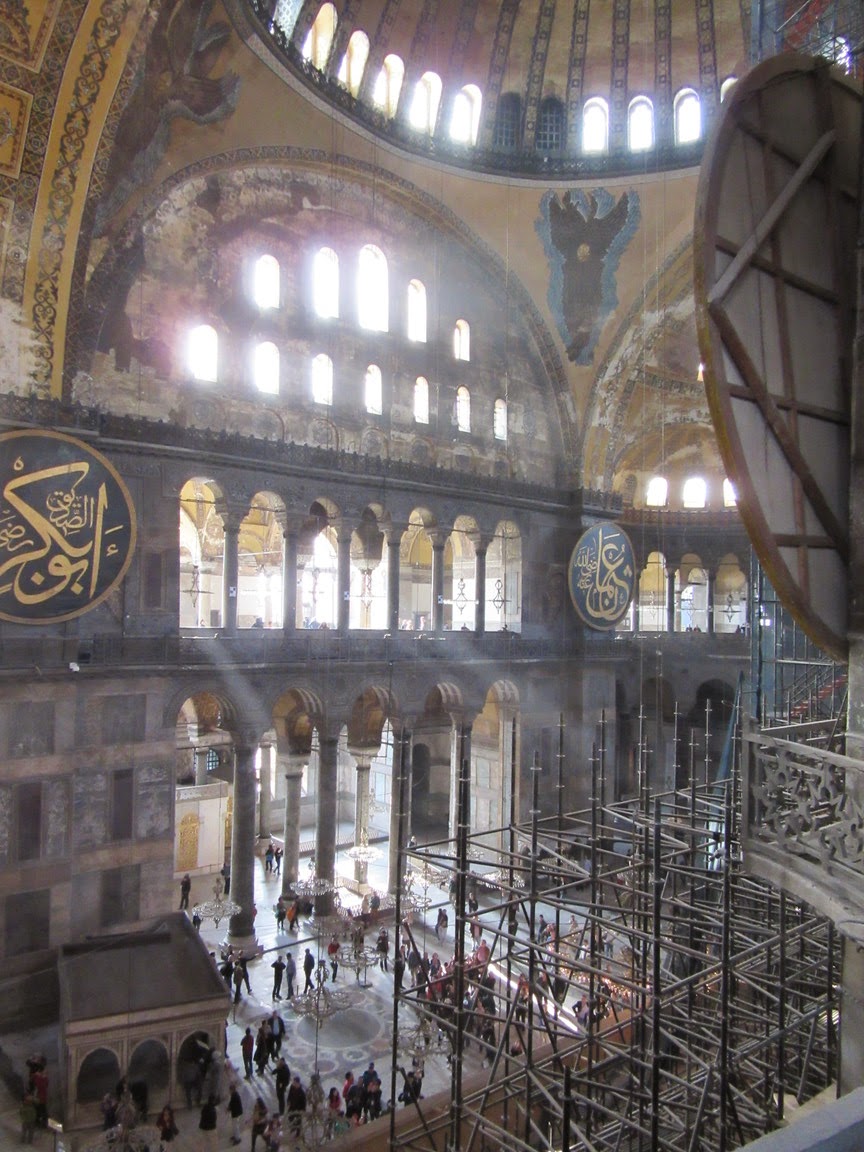
 massive!

Massive! Still!

We then went to see the Blue Mosque, me using my hoodie to conform to the head-covering requirements. I had brought my scarf just in case, but my hood seemed to work just as well; in fact, better than the scarves of many other tourist ladies. You could tell who the tourist ladies were by the sloppily-done headscarves, leaving hair poking out in all different directions (the hoodie was also a dead giveaway). Anyway, the mosque itself was fancy, with pretty designs on the walls. It was also pretty packed with all the visitors.

 the outside of the Blue Mosque, and John

big inside, too
pretty!

We ran into Mark and Joy again at the ferry port, after they had spent all day shopping, and they took the opportunity to show us some proper baklava (I always want to write balaclava). They took us to the best baklava place in Istanbul, and John and I tried a plate of 6 different types of pistachio baklava. It was delicious! Very sweet, and yet somehow we managed to finish it all between the two of us (pigs).

On our last day in Istanbul we visited a trio of museums, starting with the biggest, the Archeological Museum. We saw a range of items from Cyprus and the ancient Middle East – most interesting for me was an inscription from a tunnel built by King Hezekiah as a precaution/preparation for a siege! - as well as a bunch of statuary and archeological finds from the Istanbul area over the centuries, which mainly looked very similar to what we'd seen in the Athenian Archeological Museum.

There was also a section on the excavation of Troy, divided into the different layers which corresponded to the different settlements that had existed there. The exhibits mainly consisted of pottery shards; I believe this was because the guy excavating it was most interested in what lay at the bottom of all the layers, convinced he would find Hector's palace, so he was rough and careless with the rest of it as he dug through. Indiana Jones would be shocked! as Indy always takes the delicate approach to archeology. It's always interesting to see supposed mythical tales by Homer and the like being validated by archeology, though, so good on rough archeological dude for that part, at least.

The part of the museum I liked best was the translations of cuneiform tablets. You can look all you like at vases and pottery and not learn too much about how people lived and thought in the ancient past, but reading what they wrote provides a great window. There were mythological stories, receipts and records of loans, parts of laws and records of import taxes; there was a note about a group of smugglers, one of whom was getting cold feet, and it was up to one of the group to make sure things still turned out alright; there was also part of a letter from a queen petitioning the king from another land to send her one of his sons as her new husband, as her first one had died. There was a note under the last inscription saying that apparently the son that was sent was murdered on the way. Intrigue!!! There was a whole section of the museum closed for renovation, but even so, it took us a decent length of time to get through what was open.

Next was the Tiled Kiosk Museum, which contained brightly coloured rooms – covered with tiles, come to think of it – displaying various ceramic crockery in the centre of the rooms. We'd gazed our fill of crockery in the kitchen room section of Topkapi Palace, so we looked round this place in about five minutes.

Last was the Museum of the Ancient Orient, which both John and I found the most interesting of the three. I think I've fallen prey to the “bigger is better” mantra, and tend to find the bigger things interesting in museums. There were mummy cases from ancient Egypt, big statues of people and animals, big tiles taken from the wall of Babylon depicting mosaics of animals, big friezes displaying a procession, as well as lots of slabs depicting banquets and feasting. It must have been a popular activity back then and there.

After our museum visits it was time to be off, taking the metro for an hour to catch the shuttle bus to the other Istanbul airport. Mark very kindly accompanied us to see us off. It was perfect timing to catch the bus, which was just as well, as it took 80 minutes to get to the airport – twice as long as we were expecting – due to terrible traffic, I think. You will be delighted to learn that once we arrived, however, we got on our next flight without any problem. Whither? Come back next time to find out!

Monday, 1 December 2014

Athens


Capital City #18

We arrived in Athens having enjoyed a break from pushy salesmen and crowds of tourists. With our return to a more typical tourist destination, however, came the usual crowds of people seeking to sightsee and to sell. We ventured into at least three shops where everything was “50-60% off”! It was incredible. Such consistently incredible sales! We were hard sells, though, and resisted all the super deals so well we didn't buy a single souvenir. Bad tourists!

Our first tour of the city yielded some interesting sights, including the National Gardens, the Parliament building, the Temple of Olympian Zeus, Hadrian's Arch and many policemen around the place. Seriously, Athens had the largest police presence we've encountered in our whole trip so far – including the US. There were multiple police buses around the place, as well as small groups of policepeople stationed at various points. We're not sure if it was for something special, or is a regular feature of Athenian life. Another unique aspect to Athens was the abundance of sleeping dogs around the place, generally in the sun, some of which looked pregnant. We let them lie.

 Hadrian's Arch

leftovers of the Temple of Olympian Zeus


We also saw part of the changing of the guard ceremony (we presume) at the Tomb of the Unknown Soldier, which was a pretty great performance.


 On our second day, we visited the Acropolis, as you do, which contained the Parthenon and the Erechtheion. The Parthenon is being restored, it would seem – a task I imagine will take a while – so it joined the swelling ranks of famous European landmarks to have scaffolding around it (not all the way, though). It was definitely a big ol' fancy remains of a building. There also weren't too many other tourists there, which was nice. It's good to be in touristy places in the off-peak season.

A mostly scaffoldingless view of the Parthenon.

We made sure to explore the surrounding area quite thoroughly, and in doing so stumbled upon a couple of tortoises hanging out. That was unexpected!

 
one of the tortoises

We also saw the Theatre of Dionysos, as well as some formerly sacred caves. The Acropolis sits on the top of a rocky hill that has been enclosed in walls, so it looks like a fortress – it was used as a fortress until relatively recently, which makes sense given its commanding view over the city. The caves dedicated to various deities, or used in various rites were sometimes secret entrances into the Acropolis, useful if you're a besieging army, or a besieged populace.

looking down one side near the Acropolis

One of the views in the surrounding area - Theatre of Herodes Atticus.

We also managed to see Hephaiston's Temple in the Agora, an impressively intact structure given its old age, as well as the Areopagus, where Paul famously preached to the Athenians. It was basically a pile of rocks. We presume there was more to it in Paul's day.

 Hephaiston's Temple - so intact!

the Areopagus

The downside of visiting in an off-peak month is that the attractions close earlier. In the case of the ancient sites, this was at the ridiculous hour of 2.30 or 3 o'clock. So we ended up walking around some sights from the outside instead, which often worked fine, since you could see everything through the fence anyway. In this way we admired the Roman Agora, Hadrian's library and other ruins. Athens has lots of ruins all over the place, not just the famous ones; we'd just walk down a street and encounter a fenced-off section containing excavations, or see excavations at a metro station, discovered when they were building the metro line.

Hadrian's library (we think)

On the third day, we took a bus trip out to Cape Sounion, to see another temple – Poseidon's this time. It was an appropriate location for a sea god's temple. The temple itself was big and imposing. Perhaps we should have been more impressed by our fellow visitors, but we're not sure. We happened to time our visit with that of an Arabian-looking Muslim couple, along with a man in a suit. Another man in a suit was obviously an attendant, and another couple was showing the group round. The primary way we could tell they were important, though, was the 6-8 policepeople accompanying them like bodyguards. We made sure not to make any murderous-looking moves, so we were fine. We still don't know who they were, though. Saudi royalty? If so, we feel more important by virtue of our proximity to them. As it is, we only feel slightly more important in an uncertain way.

view from Cape Sounion
the star attraction

We managed to get dropped off near the Acropolis on our return journey, and dined at a nearby restaurant that night. We were served by the wryest waiter we've ever known. He asked us if we were going to be participating in the marathon that weekend. Indeed, the weekend we were in Athens, they were redoing the original marathon – from Marathon to Athens. We had decided not to participate in this particular event, and told the waiter so. We tipped him happily after the meal, grateful to have experienced reticence in the tourism sector for once. As for marathon runners, we saw some the day we left in Athens, running along not too far from our accommodation, with all the streets nearby closed to traffic.

That night we visited the Acropolis Museum. What were you doing on Friday night, November 7? We were at the museum late night. That's how we roll. We so down wit it. It was pretty rocking there, too. We saw many many statues of Athena, as well as the friezes that used to adorn the Parthenon and other buildings – what's left of them, anyway, which is still a fair amount, following multiple centuries and Lord Elgin's looting. ELGIIIIN! Naughty! Many of the statues were in remarkably good condition; some even had a bit of the original paint left on them. We learned this was due to the defeat and ensuing destruction of Athens by the Persians in about 480BC, whereupon the Athenians buried the surviving statues, preserving them in great condition for museum visitors a couple of millenia later!

We followed up our museum night with the National Archeological Museum the next day. This traced the history of all of Athens from prehistorical times up to about the end of the Roman period. It was fascinating to see the evolution in art style as we followed the statues through from several centuries BC to the inevitable Roman emperor busts in the first few centuries AD. Realism really came into its own in ancient hellenistic art. Most of the exhibits were statues, tombstones, steles and busts. I realized I'm used to a combination of sculpture and paintings in art museums we visit, and it seemed like something was missing at this museum – I was feeling the lack of traditional paintings. The ones that are preserved are, of course, on the vases and other pottery vessels. There was a big collection of these upstairs.

This is how you get down wit it in ancient Athens. The men are dancing with females, whom you can only just make out.

 the horse and his boy

 a theatrical mask

 two thumbs up! Another guy gambolling.

Poor Athena, not quite as attractive since she lost her nose, I imagine.

On our way back from the Archeological Museum we saw a street performance by a Korean tai kwon do group (we think). It was cool, and different from the typical busking we've seen. As we watched, we opined that this was something we would not see in New Zealand.

We finished our time in Athens by getting all the paganism out of our system with a visit to church! Like most of the others we've visited, John found it online, and saw they held to the 1689 Baptist Confession. We were so there – we're all down with proclaiming the Pope the antichrist (jks)! It turned out to be a pretty tiny church; John and I made up 1/4 of the total congregation size, though a few others joined the fellowship time afterwards. We sang the songs a cappella, and the pastor preached on Galatians 3:6-9. It was pretty great. It was nice to hear expositional preaching again, and he spoke on one of the key elements of the gospel: being declared righteous before God is only possible through faith in Jesus, rather than any works we can do. He pointed out this is what makes Christianity different from every other religion. Rather than us amassing so many righteous deeds to get ourselves declared righteous by God, an impossibility for sinners like us when standing before a perfect and holy God, God declares us righteous while we are actually yet sinful. The pastor cross-referenced a couple of passages to explain how the righteousness “counted to us” means that we are “considered as” righteous even when we're actually not. And the only way God can do this and still be just, punishing sin as it deserves, is for us to put our faith in Jesus and what He accomplished on the cross, when He bore our sins, guilt and punishment in our place. For a fuller picture of what the gospel is all about, read the Bible (maybe starting with John).

Back to our experience of the city – Athens is built quite literally on the ruins of former greatness, like an aged rock star going on tour one last time; no one wants to hear any of the new stuff, they're just there for the old hits they can sing along to, and to be part of the experience, to be able to say “I was there” along with thousands of others before. The ruins are just that – ruins, husks of buildings and monuments that hark back to the day when Athens was great. In one sense, once you've seen one marble pillar, you've seen them all, and every ruin that you visit after this is just a slightly different configuration of blocks and pillars, derelict and abandoned. In spite of that, those broken and vandalised structures still have some quality that defies objective aesthetics. That's why we were there of course, for the history. To look at the marble foundation slabs nestled in the dry grass, to climb up Mars Hill, wander through the Acropolis, and to be able to say “We were there.”

So were these people. A protest of some sort.

Wednesday, 26 November 2014

Sarajevo and Belgrade

Capital Cities #16 and 17

Sarajevo

Sarajevo is like Christchurch. While walking through the cold darkness to our hotel along the long, straight road that leads towards the airport I felt like we were walking down Memorial Ave, or perhaps Yaldhurst Road. Sarajevo is mostly on a flat area, with a river running through the middle of town (if you can call it a river). So too in Christchurch. There are hills that overlook the city – in Sarajevo they're a little bit closer, and surround the city, so they didn't remind me so much of Christchurch as Dunedin, but we won't hold that against them. They've got a confusing bus system, which is perhaps more confusing than the one in Christchurch, although I've never used the one in Christchurch – I found it too confusing. Both cities have roughly the same population size. And, of course, both have had disasters in their recent history, although the nature of disaster was very different. Whether or not either city will completely recover is still an open question.

Our hotel in Sarajevo was pretty flash. We'd tried to find the closest one we could to the Istocno bus station, which for some reason is where many intercity buses go to. This station is close to the airport, while the other main bus station is in the city centre.

The next day we came downstairs for yet another complimentary breakfast. The bread buns were equivalent to the bread we had in France (delicious). Outside the window we could see bullet holes in the building next door that hadn't been patched over yet. There were many buildings which had a smattering of puncture wounds of various calibre throughout the city – and this is many years after the most recent wars.

It was my suggestion that we should go to Sarajevo, and pop through some of the Balkans. For my first Nanowrimo book (no, you probably don't want to read it) I set the events in this area in the late 1800s to early 1900s, and ever since then I've wanted to visit. While I know a little of the earlier history of this area, my knowledge of the breakup of the former Yugoslavia is sketchy. First up we visited the historical museum, which helped a lot in explaining the conflicts of the 90s, including the Croatian experience.

I'll not try to share my ignorance here, but basically there were smaller states which made up the federation which was called Yugoslavia, and when Tito (their communist dictator for life) died in the early 1980s, the federation managed to hold together for a few years before falling apart. The different states felt that Serbia had too much influence in their federation, and decided to go it alone, one by one. This is in the mid to late 90s, early 2000s. The states are very roughly based on ethnicity/religion, but some of them had very significant minorities who didn't necessarily want to secede, and who made their own militias and declared their own mini-states.

Sarajevo is right in the middle of this, and as the capital of the Bosnia/Herzegovina state, was under siege (sieges still happen, weirdly enough) for multiple years. Hence the bullet holes in the building next to our hotel. The UN controlled the airport, and so humanitarian supplies were able to get in (and there was a famous airport tunnel too, which we didn't see) but they weren't able/willing to intervene in any direct way. Remember how I said that the hills surrounded the city? Well, imagine snipers sitting on the hills around Dunedin, waiting for people to cross the street. It's harrowing stuff, and it's surprising how peaceful the whole peninsula is right now given its recent history.

Having seen the museum, and absorbed a little history, we hit the old town area.

Sarajevo has a whole bunch of mosques, which we probably could have visited, but neither of us knew the correct protocol for doing so. I think one of the daily prayers was happening when we walked past the fanciest looking one, since there were people who looked late running in, so I didn't want to interrupt. We intend to look it up before we get to Turkey, so we won't be committing some horrendous faux pas as ignorant western tourists.

Here's a picture of the outside though.

Actually this is the fountain outside.

The rest of the old town area was filled with people who seemed to be just wandering, like us. The shops were open, and it was more like an open market, with stalls selling clothes, trinkets, metalwork – mostly traditional plates and stuff, but also bottle openers made from the spent casings of .50 cal machine gun rounds, food, and a few tourist-inclined shops. It was Saturday, so we weren't able to go into a couple of the buildings that we might have liked to, but I enjoyed wandering around.

Then we get to the main event, at least in my opinion. Right there on that corner on the other side of the road, on the right. It's nothing spectacular to look at, just a particular piece of road on a relatively insignificant intersection. The place itself isn't exiting. It's the place where Franz Ferdinand was shot way back in 1914.

The shot heard round the world.

Franz was heir to the throne of the Austro-Hungarian Empire, and since he was killed by a Serb nationalist, who may or may not have been instructed by persons in the Serb government, Austria-Hungary declares war against Serbia, which brings Germany into the conflict because of a treaty with Austria-Hungary, and brings Russia into the conflict because of Slavic solidarity (and perhaps a treaty with Serbia), which brings France into the conflict because of a treaty with Russia, which brings Germany to invade France via Belgium because it's quicker and they hope to be able to get it over and done with in time to turn around to face the slowly mobilising Russia, which brings Britain into the conflict because they'd guaranteed Belgian neutrality, which brings New Zealand into the conflict, since of course we'll follow the mother country. Such a mess. All of this happened 100 years ago this year, so I feel privileged to be able to be here at least in the centenary year. When we went to Serbia, we saw pictures of the assassin Gavrilo Princip on street corners and in shop windows – he's considered a hero there.

Christchurch and Dunedin put together can't boast that kind of history.

Anyway, for tea we had huge burgers for 2.50ish marks, which is about $2.10. They'd be much more expensive in Christchurch.

We left just as the early morning fog was burning off; from one of the hills overlooking the city we could see dozens of minarets puncturing the remaining low lying mist.

Belgrade

We arrived in Belgrade in the late afternoon – Sunday afternoon. There was no toilet stop on the 7-hour bus trip between Sarajevo and Belgrade. Just FYI. We had arranged to stay with Anna's childhood friend from her time in Kyrgyzstan, who is now living in Belgrade with her husband, working for a Christian student organisation. On Sundays we normally try to go to church, and we were able to go along with Rachel and Bojan to their church. Bojan was preaching, and Rachel kindly translated for us. It was encouraging to visit a church using another language, but worshipping the same Lord. And the initiatives planned by their student organisation, which Bojan mentioned as prayer points during the service, reminded us of some of Campus Church's work in Christchurch. We were made to feel welcome, in spite of the language barrier.

The next day we went into town with Bojan and Rachel – they live on the other side of the Danube, the side that used to be part of the Austro-Hungarian Empire, and it was easier for us to stay in the student organisation office, and bus into town from there.

Belgrade is different from other places we've been in the Balkans – it's bigger, shinier, and much more like a modern city. It was nice to be able to understand the bus system. We didn't see much of an old town, but there were a few old Ottoman-era structures – the main one we visited being the Kalemegdan Fortress.

Unfortunately not a drawbridge.

Sort of reminds me of Age of Empires II.

The view over the river.

It's built on the Danube river, right on the border between where the old Austria-Hungary ended and the Ottoman Empire began, so it was a rather important place. Strategic.

We also saw this building.

Saint Sava's church.


Such an imposing architecture. It's an Orthodox church with a capital O, so once they've finished renovating it it will be decorated up to the nines, decked out in bejewelled mosaics and Han-Solo-in-Carbonite style Mary and Jesus depictions gleaming golden in the gloom, illuminated by votive candles, with overhead chandeliers wired up with flickering LEDs.

Perhaps this is my pseudoiconoclastic reformational bent showing through, but I thought that the building looked great with the bare walls.

That evening we found the McDonald's there does a reasonable flat white. I didn't expect to have one of those again until we got back to NZ. We were also able to be involved in one of the student organisation's meetings – with pizza and Bojan interviewing different people. Good times. Such friendly people.

The next morning we posted a box of stuff back to NZ, knowing that we'd be having to reduce our luggage weight since we were flying out the next day. We had to itemise everything inside the box before the dude would post it for us.

Hoping that we'd be filled in on some Yugoslav history, we went to the Museum of Yugoslav History. Instead, since the main part of the museum was closed, we went through an exhibit showing a bunch of gifts given to Tito from different world and regional leaders – this was the ethnographic museum. It was interesting enough seeing swords and knives, hats and bags and pipes, but while the labels on them valiantly tried to give us a context to put the artifacts in, it was more of an exercise in the comparative merits of different things. Which national costume looked the most ridiculous. Which blade the most lethal. Which gun would be best to have in an apocalyptic scenario.

Also on the grounds of the museum was the so-called House of Flowers which contains the graves/tombs of Josip Broz (alias Tito) and his wife. I'm unsure how I feel about Tito; he seems to be rather a mixed character. He came to power in a post-war election which was basically a vote between either Tito and Communism on the one hand, or the old regime, consisting of a king in who was in exile in London and whose family was placed in power by the victors of the First World War. Someone thought it was a good idea to put one sovereign over a conglomeration of nationalities and regions so variegated and disparate that the term Balkanise became a metaphor for fragmentation. Sounds like a fool's errand to me. Tito managed quite well though. On the one hand, he's obviously a dictator. On the other hand, he held everything together, breaking away from Soviet hegemony, forging relationships with famous and influential people all over the world, and as far as I can tell, making a good show of things. The displays in the wings of the House of Flowers paint the picture of an okay sort of guy, sort of a globetrotting Mafia Don, sharp dressing, and sociable. Not exactly the nicest man in the world, but then, I don't know of any influential world leader who would fit that description.

You can see why it's called the house of flowers.

We also visited the Konak of Princess Ljubica. Before going there we didn't know who she was, and after leaving, we still don't know. It's a house/palace set up showing different styles of decor, how the house might have been set up when people were living there. Each room had little informational plaques on the walls telling us what the rooms might have been used for, who lived there, and the style of furnishings, from some time in the distant Ottoman past until the late 1800s or so. Downstairs was a photo exhibition on Belgrade in the Second World War, with pictures taken by a former journalist, who risked being killed each time he took a photo, with photos showing the bombing, the invasion by Nazi troops, the occupation, the bombing again by the Allies, pictures of the resistance, and the street by street fighting when the resistance joined with the Red Army (who by this time was using something like 80% captured enemy vehicles) and the liberation of Serbia.

We now have at least some idea about the more recent history of the peninsula.

That night, after joining in on the English Conversation Club, we went out with Rachel and Bojan to a ridiculously popular place for takeaways. The details are hazy on what the place was called, and even what we had to eat. I had a kebap type wrap, that used a pancake-shaped piece of meat instead of those pancake-shaped pieces of bread to wrap some more meat. The thing probably weighed about a kilo, and was delicious. It's making me hungry right now. Anna had a more traditional wrap type thing, and we were able to see how popular the place was. From the outside it looked just like one of many other fast food kiosks, with a counter and a window that you order from, except that this place had people queueing outside it. During a short lull in customers, the ladies inside never stopped cooking, they were just getting ready for the next onslaught of customers.

We said goodbye to Rachel and Bojan that evening, since we had to leave the next morning before they'd be around. It was good to stay with them, and to have their input on the best way to get around the city, and some inside knowledge on Belgrade. 

The next morning we flew out to Athens.