Monday, 24 November 2014

Dubrovnik and Kotor

Dubrovnik

The bus ride to Dubrovnik was really rather strange. The bus takes the coastal route, so much of the trip we had a view like this:

Complete with dusty windows.

The coastline in this part of the world is a little strange too. To get to Dubrovnik there's a section of road that goes through Bosnia and Herzegovina (it goes through one of those anyway, but since they're one country, it's unclear right now which one it went through). As we saw when we went through Zagreb, Croatia has a policy of checking passports for every entry and exit from the country. This became a little kafkaesque when we had our passports checked and handed back to us when exiting Croatia and entering Bosnia and Herzegovina, and again less than five minutes later when exiting Bosnia and Herzegovina and entering Croatia again. It felt like something from The City and the City. Of course with a history like the Balkans have, it's no surprise that the border is less than logical.

Dubrovnik is pretty, although within the city walls it felt a little sterile to me. Everything is made out of stone: the walls, the roads, the buildings, the churches, the monuments, and some of the souvenirs. There was rather a lot of Game of Thrones paraphernalia as well, since Dubrovnik is the location for King's Landing in the TV series.

While we were there we visited a few churches, and had a look at the memorial for those who died in the relatively recent siege of Dubrovnik, where the old town was shelled by Yugoslav forces who didn't want Croatia to secede from Yugoslavia. It's kind of amazing that such things happened in our lifetimes, but then I suppose this period of relative peace in Europe is the anomaly rather than the norm.

Speaking of conflict, there's a great – if disturbing – exhibit of war photos. We saw everything from Maoist guerillas in Nepal to Congolese child soldiers, and of course the permanent exhibition with photos of the wars during the break up of Yugoslavia. The temporary exhibition is on the conflict in the Democratic Peoples Republic of Congo, which is neither a people's republic, nor democratic. It's so very sad that a country that should be so rich on paper, is so very poor, due in large part to the mineral riches that are there for the taking. The love of money has some 'splainin to do. As does the international community (whatever that is). Obviously the causes of this humanitarian disaster (I want to use a stronger word here, but the only one that comes to mind that sums up the situation is unsuitable for print) are many and complicated, and the solutions will be more complicated, but humans are good at complicated things... Sorry about the rant, I'll continue.

We wandered down the road a little way along the coast that afternoon, missing out on a boat trip to the island.

Stout as walls.
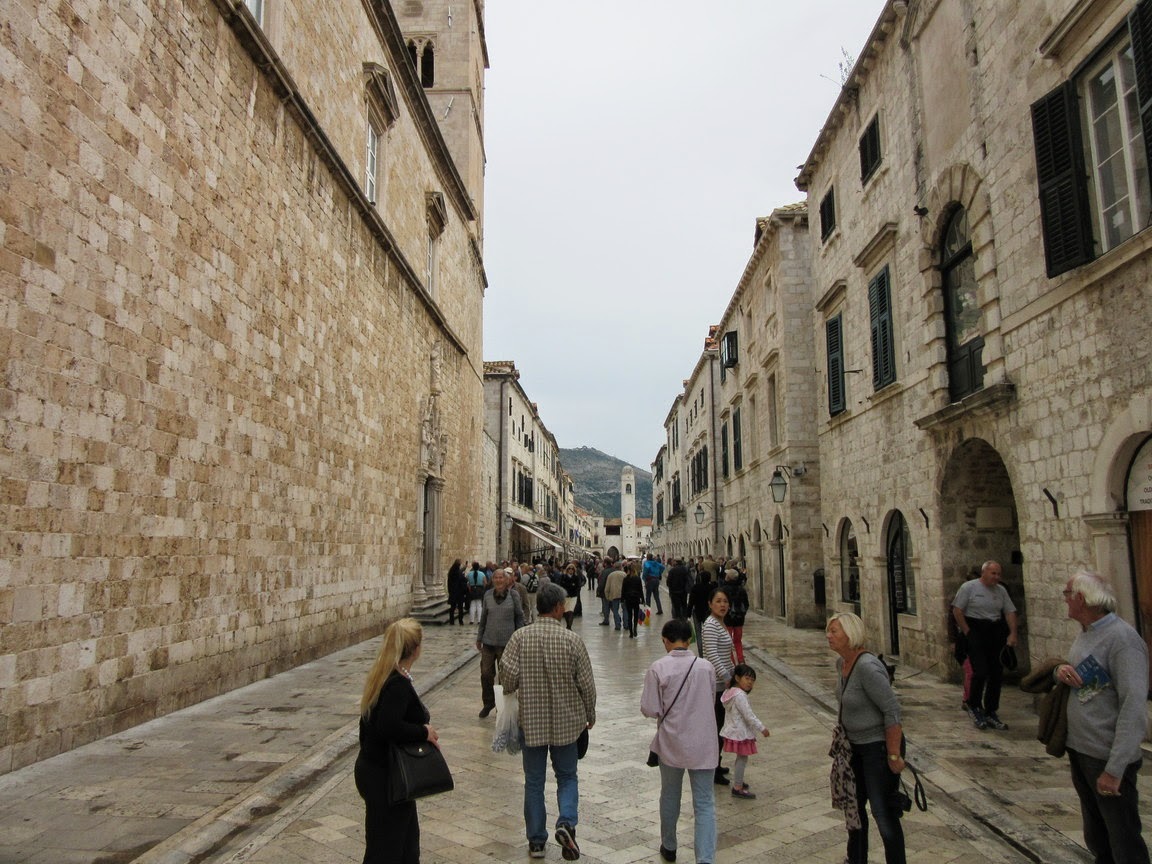
Bland streets.

Ornate churches
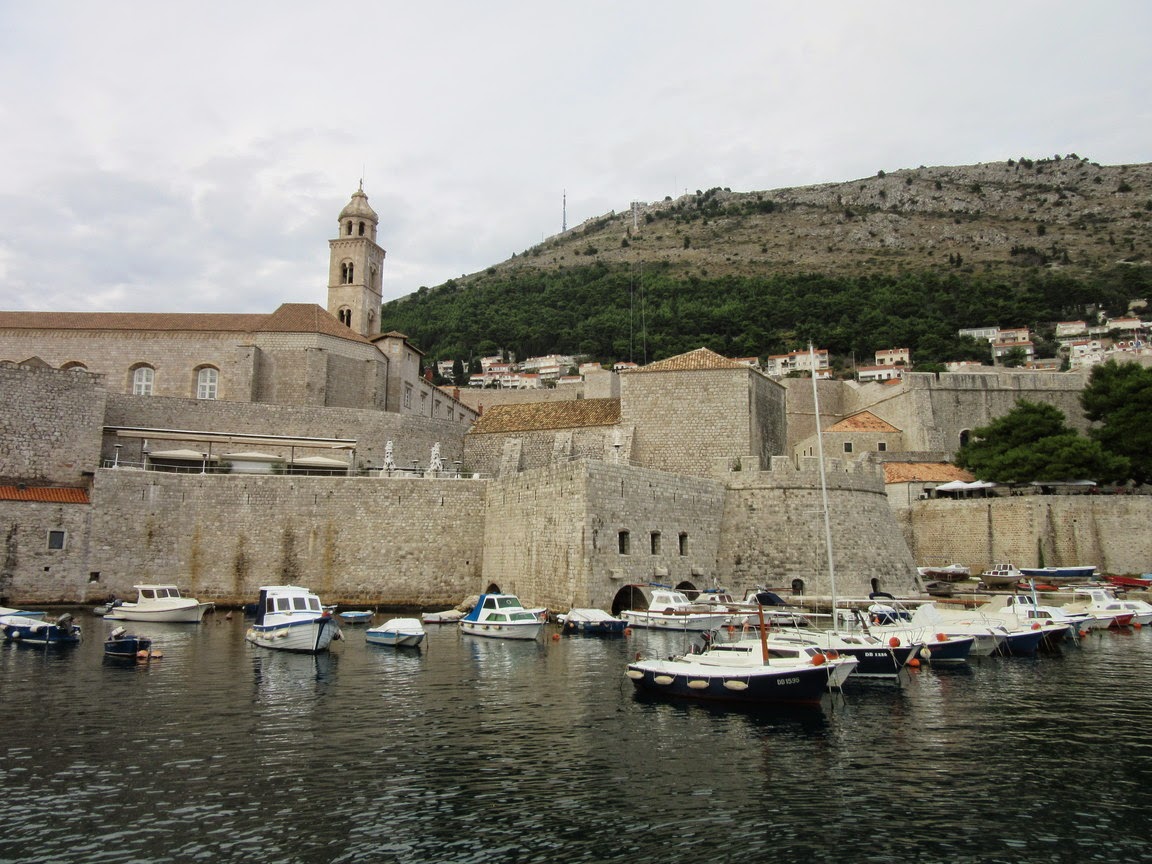
More walls

The walled city almost looks out of place here in the tropical surroundings.

Kotor

The next morning we took the bus, leaving Croatia behind, taking the long and winding road that leads to Kotor. Alright, it's not actually all that long, but it's winding. Kotor is another little walled town on the coast, this time in Montenegro. We were unsure how large it actually was, so made sure to book a place near the bus station. As it turned out you can walk across the city in about five minutes (the old town anyway). We were up about four flights of stairs' worth of stone steps, but I'm getting used to carrying the big bags up stairs. Since it was still the early afternoon we went to have a look at some of the sights.

We saw a couple of Catholic and eastern Orthodox churches, and then decided to go have a look at St. Ivan's fortress. I'm not sure who St. Ivan was, but he must have had great aerobic fitness. It was a 45 minute stair climb up to the top of the hill where his fortress was. We're no slouches either (I think I'm probably fitter than I've been in years – so much walking!) but it still took us the whole 45 minutes that the tourist book said it would. We paid 3 euros each for the privilege, and for views like this:

Actually the view from our window.


Another cruise ship, complete with cetacean-emulating exhaust system.

Parts of Kotor - not including the old town

Refreshing to be able to run around the ruins without safety restrictions.

Some old derelict church.

I'm not sure why a saint would need a fortress; maybe he was like one of those warrior monks.

Kotor was cool, and seems to be an up-and-coming place. Just after we arrived that cruise ship you can see in the photos docked, and like Jonah's whale spewed forth a belly full of cruise ship tourists, many of whom were walking up to the fortress at the same time as us. The tourist book suggests that Montenegro is trying to market itself as a more upmarket destination, and while we were in Kotor we noticed pretty flash shops, which didn't seem to be doing much by way of sales. Admittedly, we weren't there in the height of the tourist season.

The next morning we tried our luck at getting to Sarajevo. Unfortunately there wasn't a bus that went at an appropriate time for us directly from Kotor – we had to take a bus to Podgorica, and then on to Sarajevo. Unfortunately, again, it's really rather difficult to find information about the bus system in the Balkans, so we found out as much as we could about getting to Podgorica in time for what we hoped was a bus to Sarajevo. Podgorica isn't a place that I would normally talk about, but it felt different from Kotor. It was much much less tourist-oriented. It's not on the coast, it doesn't have a quaint stone city enclosed in crumbling walls; it does have a bus station though, and at that station we had this meal for just over 5 euros.


If that's the price at a bus station restaurant, I don't know what to expect in the rest of Montenegro. I imagine that in the non-tourist parts of Montenegro for a small price you can live like a king - a king with arteriosclerosis.

The rest of the bus ride to Sarajevo took us through the mountains, up through the mountain roads – some of which were unpaved. While the roads were in better condition than some of the ones we've been on in Canada, it's probably the worst road that goes between major cities in neighbouring countries that we've been on. Some parts of it are only wide enough for one vehicle at a time, so when we meet other cars we have to pull over and let them pass. As I'm typing this up now, there's a curious mix of 80s hair metal, 90s top 40, and what I assume are Balkan folk, and electronic dance songs on the speakers. The bus stops at random locations in the middle of nowhere to drop people off, who then stalk into the darkness beyond the reach of the warm bus, off into the inky blackness of the starless Balkan night. The laptop is running out of battery. I'm enjoying this part of our adventure.

Sunday, 23 November 2014

Plitvice and Split

Travelling from Napoli to Plitvice was a long-ish process. Train to Rome, train to Ancona (unexpected bus from Ancona ferry terminal to the place where you collect the tickets and then back again), through passport control, across the Adriatic via ferry (overnight, in the hold of the ship; we slept well enough). By then it was morning, and we'd arrived in Split, only to sit in the bus station waiting for a bus to Plitvice. Breakfast had been included on the ship, so we filled up on bread, cereal and coffee. Yum.

Plitvice Jezera is a National Park in Croatia. It's got waterfalls and lakes, and slightly more expensive accommodation. I suggested that we skip it. We're nearing the end of our time in Europe, and we're finding that travelling in this part of the world isn't as straightforward as it was in Spain or Italy. The railways aren't really in use, and it's hard to find information about buses on the internet. Plitvice was – as far as I could tell – too difficult to get to, given that we'd have to travel for a half day each way to get there.

We hopped onto the bus, and paid our 20 kuna for luggage (luggage is extra in this country – 20 kuna is about NZ$4).

Driving through the countryside I thought, rather profoundly: I like this country. Having come from Italy, where everything is covered in graffiti, it's a nice change to have graffiti the exception rather than the rule. There are little clusters of abandoned stone buildings scattered over the scrub-stippled hills, the infrastructure is in need of improvement, and we're beginning to see signs in the exotic Cyrillic script. Andalusia felt exotic in a Mexico-meets-arabian-nights kind of way. Croatia is exotic in a different kind of way, like a post-apocalyptic backwater, where things are falling apart, but everyone is getting on with their own business. It's also surprisingly touristy, but in a chilled out kind of way; even the people meeting you and asking if you need accommodation for the night as soon as you step off the bus just shrugged when we told them we already had a place to stay.

We ascended into the mountains and a problem became apparent. It began to rain, and then we entered a bank of fog and never left. This is a problem when you're planning on seeing things more than 20m away. We had been hoping to do a bit of that.

Anyway, we arrived in Plitvice, checked into our really rather flash hotel, and suited up to go outside again.

Did I mention that it was cold?

It was cold.

We walked out to get tickets (which we never actually seemed to need) for entry into the park and saw that the lower lakes were closed due to flooding. Perhaps this is why our tickets were half price.

The lakes area is set up quite well for walking tours. There are boats that normally take you across the lake to other trails:


Here's what the boat area looked like:


They had these bus/train things that can take you overland if you're not into walking 3-5km before starting your 3-5km walk. The problem was that the signs in the park didn't say which of the lakes were the lower ones. We made a few educated guesses, and took one of the bus/train things to where we might be able to do a walk from.

We wandered along the boardwalk at the beginning of our walk and managed to squeeze past a group of package-tour tourists, and off into the mist and drizzle.

Some sights:
Waterfalls

More waterfalls

The path was flooded, but like life, we uh, found another way. (Yes it's a butchered quote from Jurassic Park.)

That's a fire salamander enjoying the drizzle. At least someone got some kicks out of it.

There was a bunch of fish valiantly trying to jump upriver, but you probably can't see them in this picture.

The next day we had another complimentary breakfast (too much scrambled eggs and bacon and sausages and weird quasi-yoghurt and toast and cereal for me), stashed our bags, and went to see if we could see anything else.

The day was much clearer!


That's a walkway that was closed down there - but of course there were people down there still. Scofflaws gonna scoff.

It was still rather cold.

We managed to do a proper wander round before hopping on a boat (that was actually running today!) that we hoped would take us to one location, but which ended up taking us back to the beginning near our hotel. Lame.

View from the boat. We got on last, so were right in the middle of a sea of brightly coloured people.

We waited in the cold for our bus to Split, and the weather began to clear enough for a couple of patches of blue sky. At least we got some fine weather in Plitvice, even if right at the end. I'm glad we went, even though the weather didn't work out very well for us.

The bus back to Split was uneventful. Our booking.com host picked us up at the bus station (this was unexpected) and told us we looked tired (this was also unexpected).

There are a few things to do in Split – and a few to do in the surrounding regions. We had one day, so confined ourselves to Split.

Diocletian (whom you may remember as a persecutor of Christians, or perhaps as the first Roman emperor to retire) grew up along the Dalmatian coast, so it's understandable that he'd retire here also. It's also understandable when you see the view. The story goes that he retired to grow vegetables, but having seen his palace, I think it's more likely that he retired to supervise others growing veggies. The palace is/was so big that after he was long gone the town/city of Split grew up inside its walls.

Part of a church

Entrance into the palace.

Not sure what this is, perhaps the other side of the church.

Gate.

We got to see the underground levels of Diocletian's palace though, since it's being excavated. It's not really worth the price of the ticket to get in to see it, especially not when you can see parts of it for free.

Under the palace.

After this we took a walk up the peninsula. There's a hill overlooking the town.

Part of the town. It's quite a cruise ship destination.

Islands off in the distance.

There were a few old stone churches scattered along the peninsula, including this one.

Later that day we popped into the archaeological museum. It's pretty small, but we saw some interesting stuff.

Mosaic. (As an aside, I've always felt it's strange that pictures made from small tiles are called mosaics, but things related to Moses are also called mosaic.)

As a whole, Split is alright. It's kind of like some parts of Auckland with its waterfront area, and kind of like Spain, with the arid landscape surrounding an old town area. If we had more time we might have taken a boat trip to one of the islands, but we didn't, so we didn't.

The next day we headed off to Dubrovnik.

Sunday, 16 November 2014

Three ruins

South of Rome is a place called Napoli. That's Naples to any of you still clinging vainly to the anglicised version of the name.

As soon as we arrived in Napoli I wondered if it was a mistake. It seems that the further south you go in Italy, the worse the unemployment rate becomes, and the more like a third world country it seems. On every corner there were people selling things – phone covers mostly for some reason, but also pirated designer handbags, cigarette lighters, and other things I can't remember. Everyone crosses the road by just stepping out into traffic – not that the traffic stops for them at all. There are zebra crossings, so we used those when available, but when in Napoli... It felt more like Jakarta than anywhere else on our trip.

The whole point for going there though was to visit Herculaneum, and Pompeii, both of which are just a short train trip away from Napoli. We went to Herculaneum the day we arrived, and spent the afternoon wandering around the ruins.

I'll assume some knowledge of history here, but broadly speaking, both Pompeii and Herculaneum were buried by Mount Vesuvius in an eruption in 79 A.D. Herculaneum was buried in a different way to Pompeii, and so was preserved better. Pompeii is much larger, and was a much more important place than Herculaneum.

When I use the term ruins I use it rather broadly.

Check out the paintwork in this house. It's 2000 odd years old, and looks like it's from the '70s.

Just like Napoli, minus traffic.

This reminded us of Christchurch. It's in the baths. They had a raised floor, with underfloor heating. The floor partially collapsed in the earthquake associated with the eruption, but the mosaic stayed together.

... speaking of mosaics

Pompeii is the more famous ruin, and is so much larger. It's also the place where casts of people were made by the falling ash, so we can see the shapes of the people who died, mostly from the deadly gasses that the volcano spewed forth.


Plasterwork in the baths. Pompeii had a bunch of baths. This reminded me of Versailles or Schonbrunn.

Mosaic copy of a famous painting. This is Alexander the Great, as far as we can tell.

Mount Vesuvius

Many of the houses in the city were blocked off for restoration/preservation, so we could only look at some from the door.

These are wheel ruts worn into the stone.

Some of the houses had their gardens restored to what they would have looked like. I'm not sure how they know. Presumably by looking at the plant remains.

Of course like any self-respecting Roman city they had a theatre,

and an amphitheatre for gladiatorial fights.

Both Pompeii and Herculaneum are well worth the visit. Both are easily accessible via the train. The audio guide is good value at both places, although we did get a little tired of the audio-guide-man telling us we could learn more about the fourth style by pressing 108. 

In case you're wondering, yes, Napoli is the third ruin. Neither of us liked it at first, but it was beginning to grow on me by the time we left. You could say it's hectic and crowded and seedy, although dynamic, bustling and restless could also be applied.