Saturday, 9 August 2014

England

From wild, untamed Iceland we arrived in a completely different world: the civilization of England. Here, grand old buildings and immaculately manicured grounds were the order of the day, and after the ruggedness of Iceland it seemed to us that no patch of ground was left uncultivated.

After a stopover in London for the night, we picked up our rental car and drove to our first stop, Salisbury.
Salisbury cathedral has the tallest spire in Britain. Rather grand, what!

Salisbury is only 8 miles from Stonehenge, so like any good tourists, we paid a visit to the other neolithic boulders at Avebury, instead, where you only have to pay for parking and can get up close and personal to the stones themselves.
These sheep were.

So what was it like, seeing these ancient, massive boulders placed in some kind of order for some unknown reason by people all those centuries ago?

Well, it was like seeing really big rocks in the ground. The sheep in the picture above were not the only livestock around, and they'd left their mark in the grass in many places, so we had to be careful where we walked. A village had been plonked right in the middle of the configuration of stones, as well, as the circle of stones extends for quite a distance, so it was a curious mixture of old meets new.

John's fearsome strength is countered by this immovable object.

Having been duly awed by the size and grandeur of the ancient stones, we journeyed on to Bath. We liked it so much we visited again the next day! It was a most lively place, with buskers (some pretty good!), tourists and general crowds thronging the lovely town centre. We sampled some traditional cornish pasties for lunch, and they were very nice. I could get used to sampling all this exotic food!

A very sensible monument.

As seemed only fitting, we visited Bath's namesake, the Roman baths. It was an evening visit, which was quite cool - especially so, as all throughout our time in the UK it was amazingly warm/hot! We religiously listened to all the audioguide commentaries, so it took us 2 and a half hours to get round it all.

A drain.

We refrained from swimming in the actual baths themselves.

The next day we checked out the Fashion Museum, charting the evolution of fashion in Bath from the Georgian times to the present day. Sure, they had guys' clothes too, but mainly this was a chance to look at beautiful to outrageous dresses.

Outrageous.

I love the shape - but just slightly overdone in the styling, perhaps.

Pretty!!!

So pretty!!!!

We also stopped by the Jane Austen Centre, and learned all about how she did like Bath as a place in general, but not as a place to live; consequently, she wasn't very happy during the time she lived there with her family. Although Bath served as a source of some inspiration for her later writing, it didn't inspire her to write anything while she actually lived there.

Mrs Bennett had stopped by and left a message! She spells her name slightly wrong though...

During our time visiting Bath we stayed at an airbnb which was an apartment in a converted church building, built in about 1870. It was a great place to stay - it had been renovated, so was completely modern (apart from the stone outer walls), but it also had a massive round stained glass window in the living room, and several small windows in our room in unusual, unexpected places.

On our way north, we stopped in a very pretty little town called Stow-on-the-Wold for dinner. It seemed beautiful and quaint, with its small size, old buildings and cobbled streets. I felt it gave us a proper taste of tiny English villages - it was utterly charming, and relatively quiet in the evening, especially compared to Bath. This may sound strange, but it reminded me of what I anticipate Italy will be like.

We then passed through Stratford-upon-Avon, on a Saturday when it seemed there was an event on, and consequently HORDES of people. Once we had undergone the taxing rite of parking, however, it was a pleasant place to wander around. We joined the multitudes of tourists to behold Shakespeare's birthplace from outside. We also saw a "friendship flower bed" that paid a mention to its sister towns, one of which was Taranaki's Stratford!

Hamlet looking a bit tortured.

In our final day of gallivanting around the English countryside, we checked out the Peak District. We visited Lyme Park, which is most famous for The Lake that Mr Darcy emerges from in Pride and Prejudice (the only proper version - I trust I don't need to specify). We took a tour of the grand manor, a flying visit of the gardens, and I took a couple of photos of the lake.


The grand but slightly faded old manor with John.

The lake, although pretty, just wasn't quite the same without Colin Firth.

We also rambled about Eyam village, the "plague" village, famous for how many of its inhabitants were killed in the Black Plague. Some of the cottages had plaques outside, by the road, listing who had lived and died there during the plague. It was sobering to see the devastation it caused families; one family of nine was completely wiped out; in another house, one lady survived, but lost 24 relatives (including in-laws).

All in all, England was a beautiful place, in a far more stately and historical kind of way than Iceland. The accents were also neato, and I found myself thinking more ponsily. We could have stayed longer quite happily and explored more, but London was calling...

Wednesday, 6 August 2014

The return of the Þing

There are certain things that as New Zealanders we take for granted. Things like being able to go to any country we want to, without having to mess about with visas. Things like being protected from financial crises (due perhaps to our isolation, or our reliance on agriculture), and that we'll be able to go to a McDonalds in any country, and order a Big Mac combo, with large fries and a chocolate milkshake that is a close enough facsimile of what we're used to. That whaling is wrong.

While there are certain similarities between NZ and Iceland, both being island nations with small populations, seismically active, on the outer corners of civilisation, it's when the things we take for granted are not there, that you know you're really in another country.

Case in point: There are no McDonalds in Iceland. It's not financially tenable for them to continue after the financial crisis, so they pulled out.

Case in point #2:
Whale steak

It tasted alright, was blubbery (as is to be expected) and was a little stringy. I kept feeling that someone was going to jump out and demand that I rescind my new Zealand citizenship, but no one did, and there it was on the menu, along with horse and spaghetti bolognaise. The waitress informed us that it was Minke whale, and she didn't seem to have a problem with me ordering it.

Despite its isolation and emancipation from the shackles of certain aspects of globalisation, there are certain things that seem to be truly inescapable.
Nile Rivers

Share a Coke with Jaroslaw! (we didn't know anyone with that name, so we just shared it between us)

Anyway.

Extinct volcanic craters anyone?

Grábrók. This reminded me of Mount Eden.

Working our way back down the western side of the island, we tried to find a bunch of different things that the little booklets we got at the tourist office said were there. Some of these our trusty GPS knew about. Others, we had to make some guesses, trying to follow the description in the book. Sometimes there were signs, and sometimes they were in English, but all in all, they could do with either better signposting, or better tourist booklets. Anyway, some of our finds:

Glanni Falls

Deildartunguhver. Biggest volume hot springs in Europe.

More Deildartunguhver. This is the river that it flows into. They use this for heating, pumping it to the surrounding towns.

By that time, we were almost in Reykjavik, capital city #1, and took the tunnel under the harbour.

The next couple of days were spent doing the 'Golden Circle' activities that most tourists do. Geysir, Þingvellir, Gullfoss, and the Blue Lagoon.

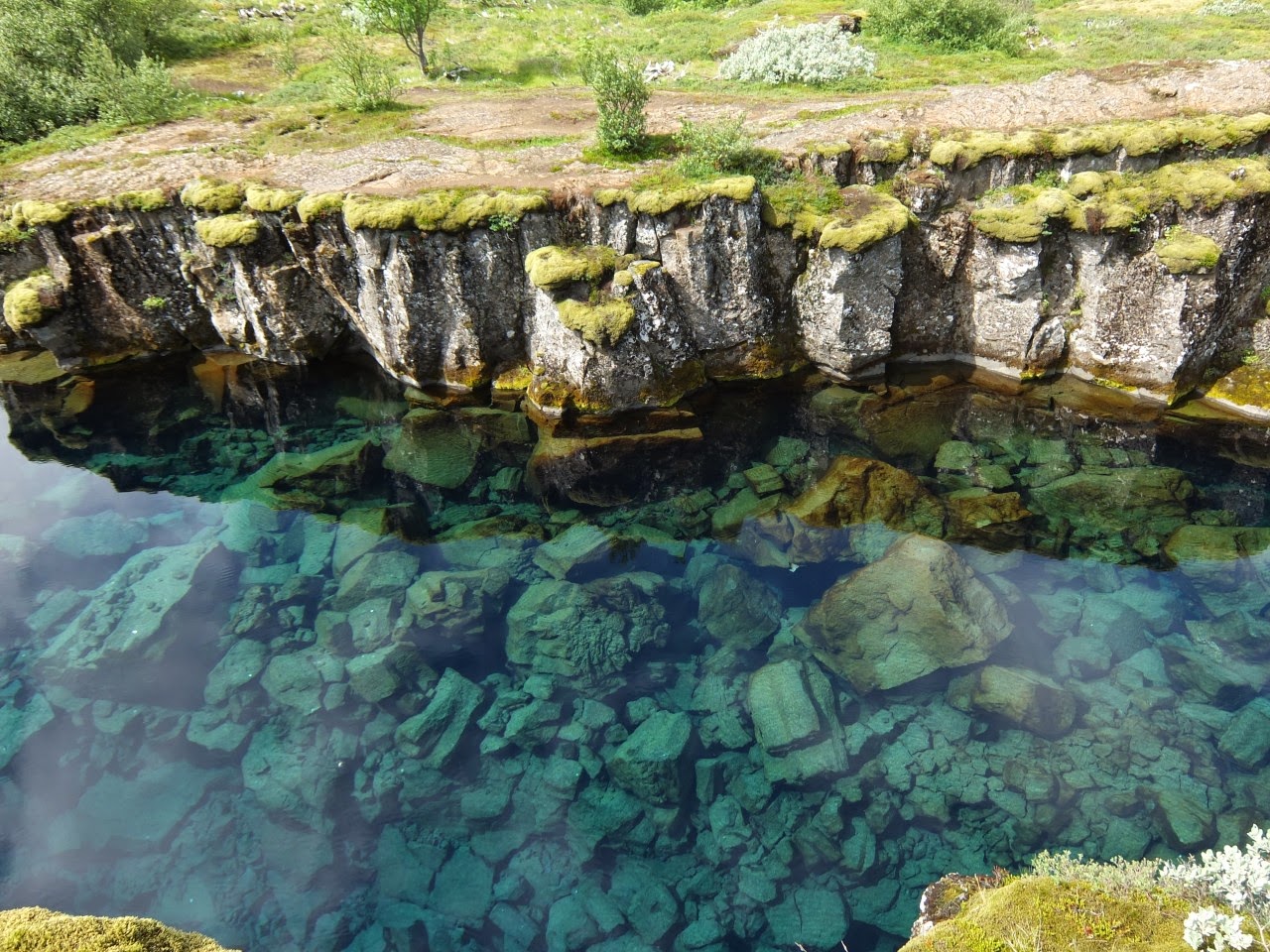
Þingvellir is a valley caused by two tectonic plates pulling apart (correct me if I'm wrong here Grant). It's the only place in the world that this happens on the surface. All the other ones are at the bottom of ocean trenches.

The view of the lake. Those towers of stones are presumably not a natural phenomenon, although we saw them all over the place.

It's also the site of the oldest parliament in the world, the Alþing, just so you're aware that when you call something a thing, you're using the same word the Vikings used to describe their parliament: it's a thing.

This is what everyone comes to see.

It's a truly amazing place. That's actually a reflection of the sky, not a tear in the space-time continuum.

You can tell why people go scuba diving here.

Next up is Geysir.
Here lies Geysir, the first of his name.

Who would have thought that a blog post about Iceland would have so much etymological information in it? The original Geysir used to erupt often enough that it became a tourist attraction. People used to encourage it by throwing soap into it. Not anymore though. Geysir has been dormant for a while now, and only erupts before earthquakes, or for special occasions.

Thankfully though, Strokkur is more obliging, erupting every few minutes:

People standing around.

People standing around looking at Strokkur.

Next up is a rather large waterfall. Probably the biggest one I've seen to date. Behold Gulfoss:

Note the tiny pilgrims on the left. For scale of course.

Lastly, on the way out of Reykjavik, as you go towards the airport (which is actually in Keflavik) there is one more famous tourist destination.
The Blue Lagoon sounds like the title of some gothic novel, but as you can see, it is indeed blue.

The Blue Lagoon presumably has some fancy icelandic name, but I can't find it on the paperwork that we brought back with us. Some things you'll want to know about it:
Q. Can I swim in it?
A. Yes you can swim in it. That's a photo of a part outside which may or may not be fit for swimming.

Q. How much does it cost?
A. Like everything in Iceland, it's a bit expensive. roughly $60 NZD each. But you're only in Iceland once, right?

Q. Was it worth it?
A. No, not really. Apart from the Martian scenery, which you don't really notice, it was a hot pool with blue water. They did have free mud that you could spread on your face though, which was nice.

Despite the cold and rain that we experienced earlier on in the week, I think Iceland is one of my favourites of the places we've visited so far. It's eerie and otherworldly. Looking back on it, some parts of the trip feel like we were driving through a dreamscape, and that it wouldn't be out of place to go around a corner to find a dragon there. Or a spaceship. Iceland is truly a fantastic place. You should visit.

That's it for Iceland. We've been without robust internet recently, and so are rather behind. Hopefully we'll catch up soon.

Saturday, 26 July 2014

A Land of Ice and Fire

Full disclosure: Iceland is a wonderful place. Seriously. Go visit.

You might think that with a name like ICEland, we'd be ready for the cold. You might also think that we wouldn't plan a 500km drive on unfamiliar roads right after a late night flight that only lasted 4 hours, 3 of which were spent not sleeping. If you thought such things, you'd be wrong.

The idea originally was that Iceland would be a nice place to visit if things worked out, so it went on the list of countries to visit if it's not out of the way. It turns out that the cheapest way to get from Halifax to London is via Iceland, and so we decided to make a week of it, driving around what's called the 'ring road', and catching up with some of the sights.

The first day is a haze, so there aren't any photos. Primarily because I was driving, Anna was sleeping, and we didn't stop anywhere along the way, except for me to snatch an hour or so snooze. Also the weather was atrocious, and neither of us felt like braving the elements for a picture of fog.

Vatnajökull is a ridiculously large glacier that covers more than 8% of the whole Icelandic landmass. There are a bunch of volcanoes underneath it. We decided to see one edge of the glacier as it flows towards the sea, into a lagoon. Behold, Jökulsárlón:

Thank goodness for those jackets.

There were a whole lot of people there, just hanging out, taking photos. Also there were a whole lot of birds:
Arctic Terns (I'm pretty sure). We'll get back to those in a sec.

A Skua contemplating the meaning of life. Probably someone else's life.

Some sort of duck, and her friends.

Another one of the lagoon, just because.

The lagoon is visible from the main road. It flows into the ocean a couple of hundred metres downriver, so icebergs that are small enough float down the river into the ocean, and are promptly washed back on shore.


They're kind of slippery. And kind of large.

Anyway, back to the arctic terns. There were heaps of them, filling the skies as they swooped down to catch little fish in the river, then flew back to their nests, which were just sitting there in a field by the car park. I wondered idly how they protected themselves from predators, if they're all nesting there. Walking back to the car we found out.

Nathan, if you're reading this, you may want to skip the next paragraph.

It turns out that they dive-bomb. Not actually dropping things (that'd be silly) but more like kamikaze pilots. Birds started making angry sounding noises at us, and flying towards us in a threatening manner. Our stroll back to the car park became a run, as innumerable terns attempted to see who could swoop closest to our heads. Despite our waving arms, one managed to get through our defences and took a nip/scratch out of my scalp. I suppose being a taller target, I was the one to get that particular souvenir. No photos of that, you'll be pleased to hear.

The next day we drove to a little town in a fjord called Stöðvarfjörður. What are those fancy letters there that look like a cross between a d and a t? We had the same question. Apparently it sounds like the th in them. The other fancy letter that they use is the þ seen in words like þingvellir. It's also a th sound, although it's a th as in thistle.


This is what much of the coast looks like. Rugged as.


Struggling to eke a living out of the land.


There are countless waterfalls dribbling over the edge of the plateau, most nameless.

The weather was pretty terrible, if we're honest, at least for this part of the trip, so apart from driving, and injuring myself on the head again, we didn't do much, until we got to Akureyri.

We stayed in this room for a couple of nights.

Because of the way we'd scheduled our itinerary, we backtracked a bit. Here are the highlights of the north of Iceland:
Goðafoss. (foss means waterfall. True story)

That lake is actually a powder blue colour. Also, not for swimming in.

F road.

We took one of the F roads to try to get to see one of the larger, more spectacular waterfalls, and it took us an hour or so of this driving through terrain like this. It would have been spectacular if we could see anything.

At the end of the road, we came out next to a place called Ásbyrgi. The guide said it was a horseshoe shaped canyon. Boring we thought. We were wrong. It also had biting insects! And sunlight (finally) which warmed our hearts and bones as we wandered along a path, past vertical rock walls and spindly trees to this spot:

Tiny people for scale.

Bigger person for scale.

The thing about Iceland is that during the summer, the sun never really sets, only goes into an extended twilight, and sort of comes out of it again at 'dawn' at around 2am. We decided that there were enough sunlight hours to see that spectacular waterfall we'd driven along the F road to see.

Because it had been raining for a while, the trail to the viewing area was damp.

I was there, see?

Here's one from the drive back, just showing how strange the landscape really is. I kept thinking that this is what Mars will look like if it's ever terraformed, with all the stunted plants and rocky scenery:

This will have to do for the first instalment - stay tuned for more Iceland soon! Hopefully.